Skill drill
Double-Line Winch Pull with a Snatch Block
The line runs out to a snatch block on the anchor and back to the vehicle, roughly doubling the pull at half the line speed.
11 steps, about 3 minutes
Rig it in 3D one decision at a time. Choose wrong and you will see what happens.
When to use it
When a single line is not enough: the vehicle is buried deep, the pull is uphill, or the anchor is close and you would otherwise be pulling on the drum's weaker outer layers. Expect about twice the pull at half the speed, with twice as much line out.
The steps
- Gear up
- Pick the anchor
- Protect the anchor
- Hang the snatch block
- Spool out
- Connect back to the vehicle
- Dampers on
- Clear the area
- Take up the slack
- Winch it out
- Secure and spool in
A drill is practice, not certification. Read your own winch's manual, and learn it hands-on from someone experienced before you rely on it.
The written guide
Step by step
- 1
Gear up
Put on heavy leather gloves and clip the hook strap to the hook. Use the strap any time you handle the hook, never let the line slide through your hands, and never hold the hook itself.[1, 2, 3]
Winch lines carry burrs and broken strands, and the fairlead is a pinch point. The hook strap keeps your fingers out of it.
- 2
Pick the anchor
Choose a solid, live anchor straight in front of the vehicle. On a double-line pull it carries the load of both lines.[4, 8]
The block's anchor sees the pull from both lines at once, so it has to be the strongest anchor you have.
- 3
Protect the anchor
Wrap a tree-trunk protector strap around the base of the trunk, as low as you can get it and without twisting it. Never wrap the winch line itself around a tree and hook it back onto itself.[1, 3, 5, 6, 7]
A low strap keeps the tree from levering over and spreads the load so it does not cut through the bark. Hooking the line back onto itself crushes its strands.
- 4
Hang the snatch block
Shackle the snatch block to the eyes of the tree strap. Use a block rated for at least twice your winch's line pull.[3, 4]
Two lines pull on the block, so it carries about twice what the winch pulls.
- 5
Spool out
Put the winch clutch in free-spool and walk the line out by the hook strap, keeping a little tension on it so it does not kink or tangle. Leave at least 10 wraps of synthetic line on the drum, or 5 of steel.[1, 2]
The point where the line is fixed to the drum is not built to hold load. The wraps hold it. Slack line walked out loosely can twist and wind on badly later.
- 6
Connect back to the vehicle
Bring the line back from the block and shackle the hook to a rated recovery point mounted to the vehicle's frame, never to the winch or its mounting plate.[2, 3, 4]
On a double-line pull the vehicle end takes up to twice the winch's pull. Only a rated, frame-mounted recovery point is built for that.
- 7
Dampers on
Lay a line damper, a recovery blanket or weighted bag, over the middle of each of the two lines before you put any tension on them.[1, 2, 4]
If the line or a piece of hardware fails, the damper's weight pulls the line toward the ground instead of letting it whip back at the vehicle. Never walk up to a loaded line to move one; slack it first.
- 8
Clear the area
Before the line takes any load, move everyone back at least 1.5 times the length of line you have out. Nobody stands in front of or behind the vehicle, near the line, or near a snatch block, and nobody steps over the line.[1, 2, 3, 7, 8]
Anyone near a loaded line is in its path if something fails. Sources set the keep-out distance anywhere from the full length of the line to twice it; this drill uses 1.5 times, the Victorian government's figure.
- 9
Take up the slack
Engage the winch clutch, pass the remote cord in through the window, and spool in slowly just until the slack is gone. Stop, and check the anchor, the strap, the shackle and the hook before you load it.[1, 2]
A slack line that suddenly loads hits the whole rig with a shock. Checking at light tension catches a bad anchor before it carries the full pull.
- 10
Winch it out
Keep the engine running and the transmission in neutral. Winch in steady pulls, pausing to let the motor rest and to check the line is winding evenly onto the drum.[1, 2, 9]
A running engine keeps the battery up under the winch's draw, and short pulls with rests keep the motor from overheating. Jerky loads are the ones that break hardware.
- 11
Secure and spool in
Put the vehicle in park or a low gear before you release the line tension. Then spool in, walking the line with the hook strap so it winds on evenly, and stop with the hook about 3 feet from the fairlead.[2, 3]
The vehicle has to hold itself before the line goes slack. Powering the hook into the fairlead can damage both.
Avoid these
Common mistakes
An underrated snatch block
The block takes the load of both lines. It must be rated for at least twice the winch's line pull.[3]
Hooking back to the winch mount
Return the line to a rated, frame-mounted recovery point. The front of the vehicle can see up to twice the winch's pull.[3, 4]
One damper for two lines
Put a damper on each line. Either one can carry the energy back toward the vehicle if something fails.[4]
Watch & learn
Double-line pull on video
Picked from our video library. These are other creators' videos, so where one differs from the drill, the drill's sourced steps are the ones to follow.
How To Perform A Double Line Pull Using Factor 55 Accessories And A Winch
Warn Industries
0How to perform complex winching techniques | 4X4 Australia
4X4 Australia
0Winching Double Line Pull
Emergency Australia
0
Keep practicing
Other winch techniques
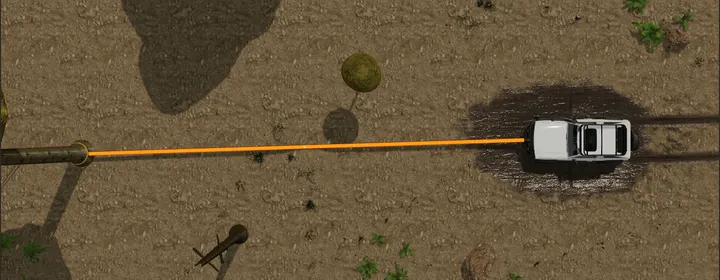 Start hereSingle-line pullThe basic self-recovery: one line from your winch straight out to a solid anchor in front of the vehicle.10 steps
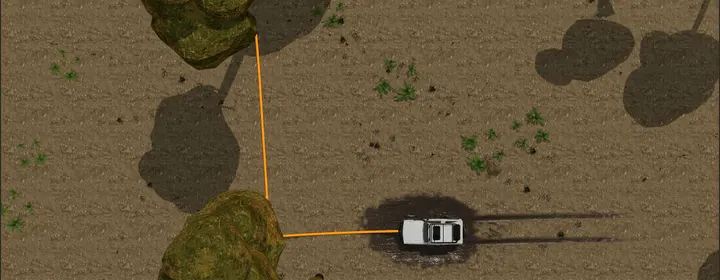 Technique 3Redirect pullWhen the only big anchor is off to the side, a snatch block on a second anchor in front turns the line so it feeds into the winch straight.11 steps
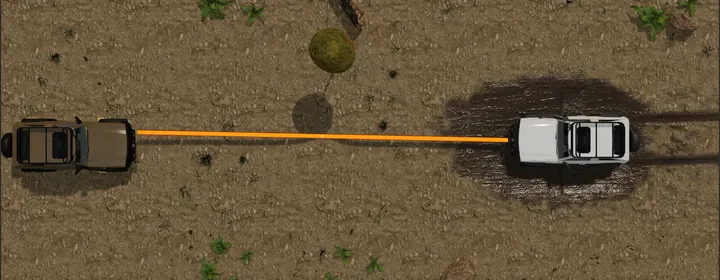 Technique 4Vehicle as anchorNo tree in reach, but a second vehicle on firm ground can be the anchor, as long as it is set so it cannot be dragged.10 steps
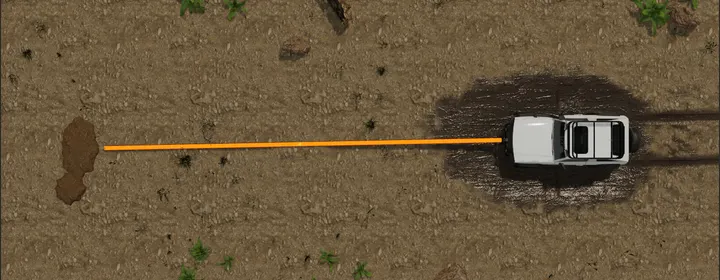 Technique 5Buried anchorOpen ground, no trees, no second vehicle: bury your spare tire across the line of pull and winch to the ground itself.10 steps
Learn it hands-on
Nothing replaces practicing with someone who has done it. Browse off-road tour operators and parks near you and ask whether they run recovery training.
Find off-road tours and parksSources
Where the checkable claims above come from. Rules and figures change, so confirm anything you are about to rely on against the source itself.
- Basic Guide to WinchingWARN Industries (warn.com)
- The Basic Guide to Winching Techniques (62885A6)WARN Industries (quadratec.com)
- Electric Winch User's GuideSuperwinch (Westin Automotive) (westinautomotive.com)
- Double-Line Winch Pulls: Why, When, and HowFactor 55 (factor55.com)
- Recovery Basics: Part IARB USA (arbusa.com)
- Winching Basics: Protect Those Trees and Be SafeTread Lightly! (treadlightly.org)
- SOI-034: 4WD Vehicle Winch (Safe Operating Instructions)Victoria State Government, Department of Environment, Land, Water and Planning (files-delwp.em.vic.gov.au)
- ATP 4-31: Recovery and Battle Damage Assessment and RepairUS Army (published by the North Carolina National Guard) (ng.nc.gov)
- Winch User Guide (9923644)Polaris (publications.polaris.com)