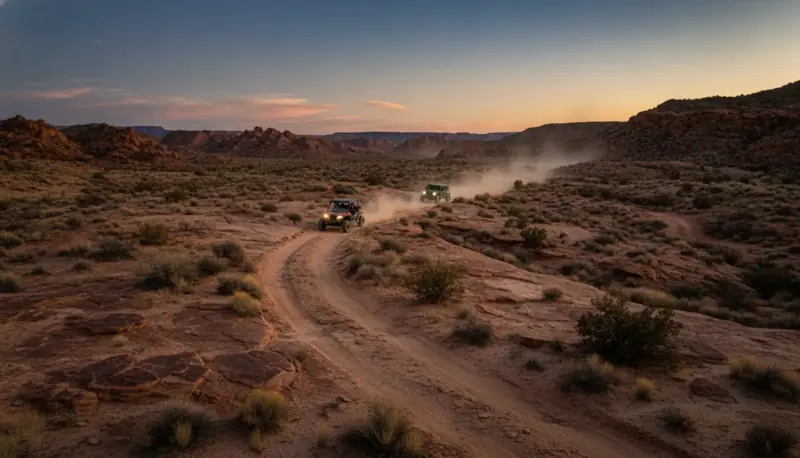
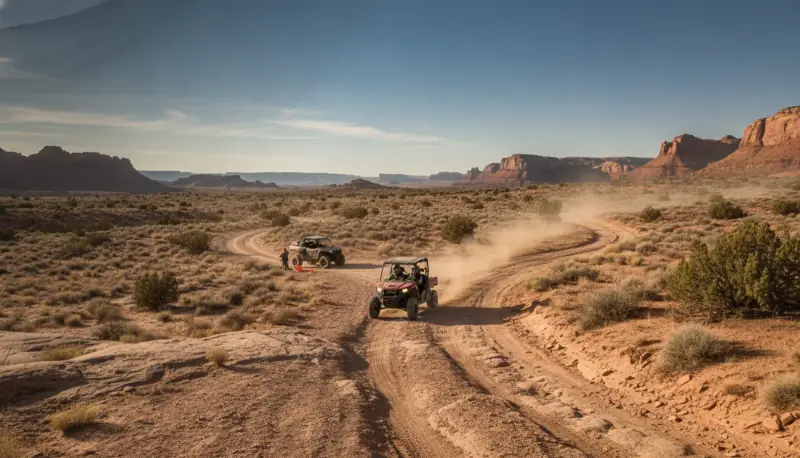
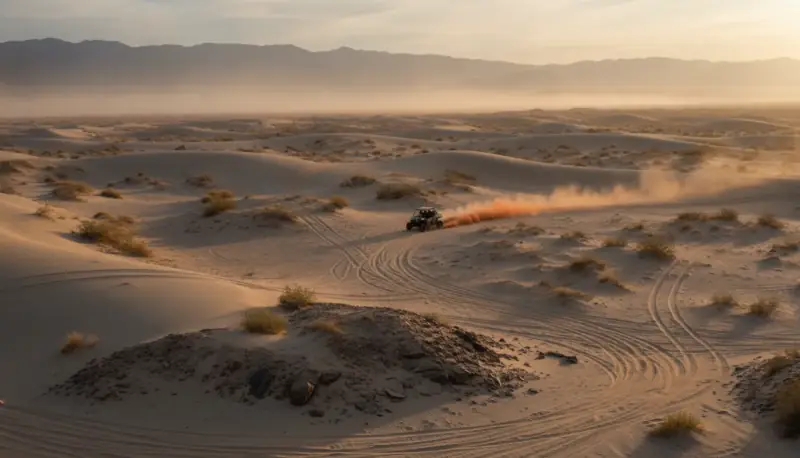
Every OHV driver learns the hard way that rocks, roots, and washouts don't care about your vehicle's bumper. One poorly placed impact can strand you miles from help with a damaged fuel tank, transmission pan, or transfer case. Professional overlanders and park veterans invest in underbody protection not as a cosmetic upgrade but as crash insurance. This guide breaks down the core armor pieces (skid plates, traction boards, and lifting jacks), that turn a vulnerable stock vehicle into something that actually belongs on rough terrain.
Why Vehicle Armor Matters on the Trail
Stock vehicles have clearance measured in inches, not margins for error. The transmission pan, fuel tank, differentials, and cooling system sit inches below the frame, exposed to rocks, stumps, and dried creek beds that don't announce themselves. A single impact can punch a hole in your fuel tank, lock up a differential mid-descent, or shear transfer case mounts. Recovery then means waiting for a winch-equipped buddy, a tow truck (if cell service exists), or a very long walk.
Armor adds a sacrificial layer between your vital systems and the terrain. Unlike cosmetic plates that bolt on and look aggressive, proper underbody protection is engineered to absorb impact forces and distribute them across the vehicle's structure. Most OHV drivers running serious terrain carry a mix: skid protection for the usual suspects (oil pan, transmission), rock sliders to prevent high-centering on boulders, and belly armor for the fuel tank and transfer case. The cumulative cost isn't cheap (a full package runs $1,500–$4,000 depending on material and coverage), but it buys peace of mind and faster recovery when things go sideways.
Skid Plates: Protecting Your Undercarriage
Skid plates are single-point armor for a specific system: engine skids shield the oil pan and drain plug, transmission skids cover the pan and tail housing, fuel-tank skids wrap the tank, and differentials get their own design, often with bash-plate wings.
The material choice matters more than the brand:
| Material | Typical thickness | Strengths | Trade-offs |
|---|---|---|---|
| Steel | 3/16" | Dents instead of cracking; spreads impact; field-repairable with a hammer | Heaviest; rusts if neglected |
| Aluminum | 1/4" | Much lighter; corrosion-resistant; easy install | Absorbs less impact; gouges on sharp rock |
| Composite / UHMW | 1/4"–3/8" | Lightest; slides silently over rock | Flexes under hard hits, passing stress to the mounted system |
Installation matters as much as material. Skid plates should bolt to the frame rails or chassis, not hang from the bumper or suspension, poor mounting turns a skid into a debris catcher that tears itself off on the first obstacle. Quality plates use 1/2-inch bolts in thick bosses to spread load and prevent fastener shear. And check your geometry: on platforms with shallow approach angles, a skid that extends past the bumper catches everything. Factor that into route planning.
Traction Boards: Escape Tools That Work
Traction boards are rigid, ridged boards you lay under your tires for grip on sand, mud, or snow. The two most recognized names are both Australian: MaxTrax (rigid one-piece nubbed design in UV-stabilized reinforced nylon) and the TRED Pro (dual-composite construction with fixed, progressively tapered teeth molded into a reinforced rib structure).
| MaxTrax MKII | TRED Pro | |
|---|---|---|
| Weight per board | ~7.5 lbs | ~8.8 lbs |
| Build | One-piece nubbed nylon | Dual-composite, harder tooth material over a flexible core |
| Where it shines | Deep sand and soft mud, stable, stiff platform | Repeated hard pulls on rock and clay, teeth resist chunking |
Both work; neither is a meaningful space-saver over the other. A pair is the practical minimum, four boards let you place two front and two rear when you're high-centered.
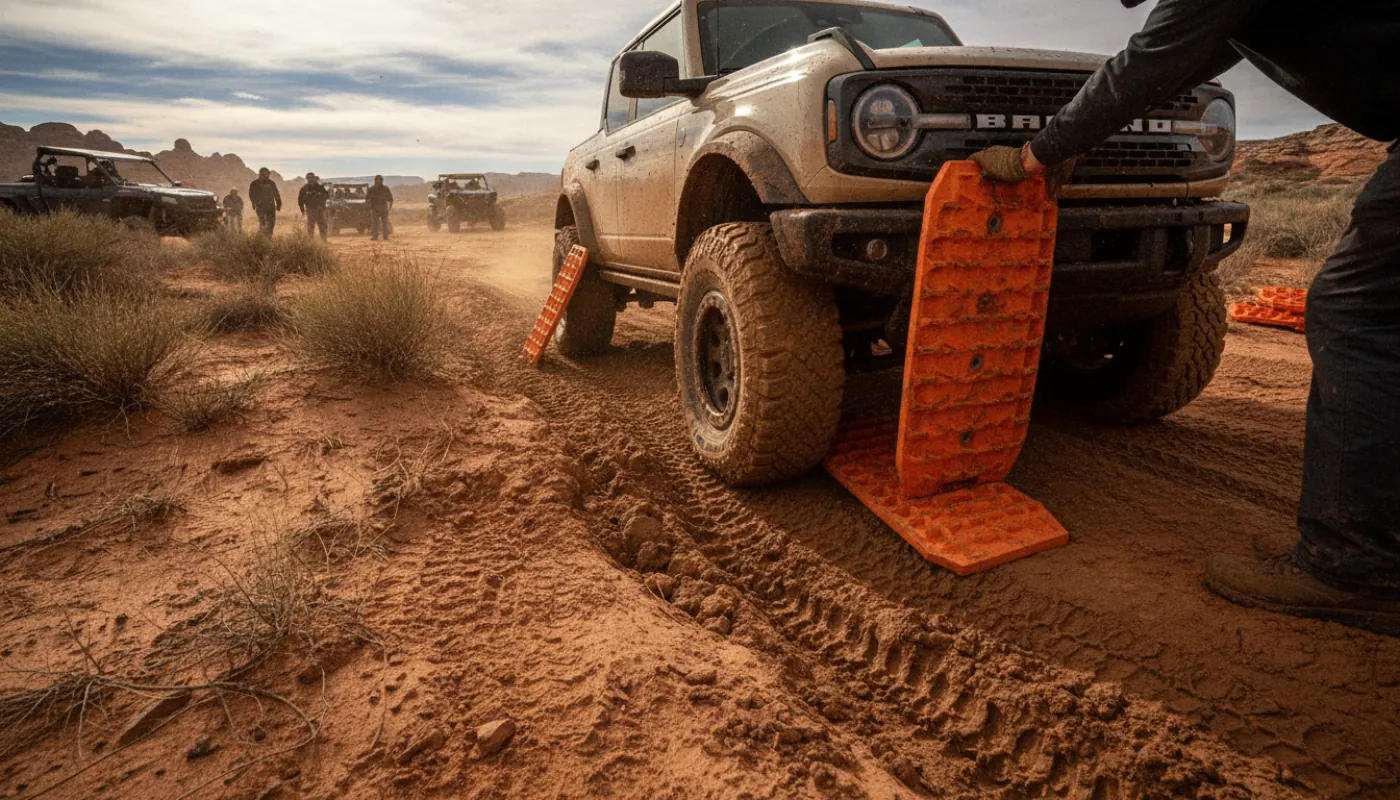
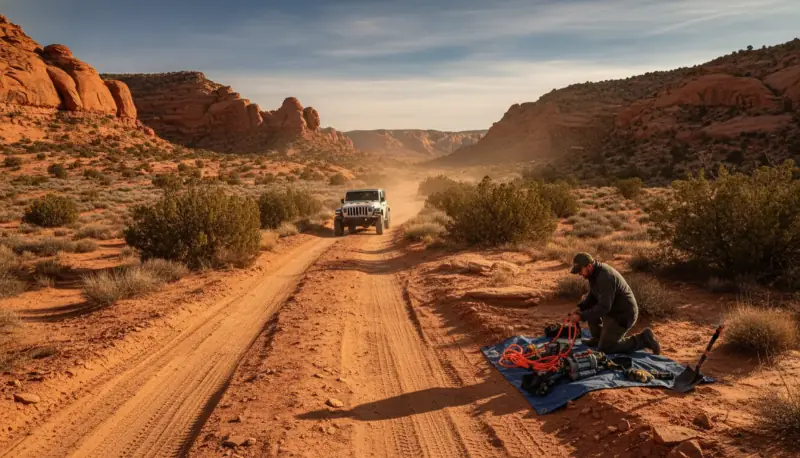
The practical difference emerges when you're stuck: dig out your high and low sides, lay the boards under the drive wheels at a slight upslope angle, and engage a low gear. Where most drivers fail is deployment speed, digging and placing boards takes 10–15 minutes per attempt, which is one more reason parks recommend traveling with a partner or group. In really deep sand you may need to leapfrog boards or combine them with a kinetic rope for stubborn situations.
Hi-Lift Jacks vs. Bottle Jacks: Choosing Your Lift
A hi-lift jack (farm jack) is a mechanical lever rated to lift about 4,660 pounds, roughly three feet of usable travel on the common 48-inch model, using nothing but mechanical advantage. A bottle jack is a hydraulic cylinder that lifts less height with far less effort. Overlanders argue endlessly about which belongs in the kit, and the real answer is: both, or at least a clear understanding of the trade-offs.
Hi-lift jacks win on versatility and reliability: they work in extreme cold, never leak fluid, and a broken one is field-repairable with basic tools. They lift high enough to stack rocks under a hung-up axle, and they double as a hand winch (come-along) with minimal extra gear. The downsides are real: they demand both hands, technique, and upper-body strength; they're slow; and a loaded handle that slips can break a jaw or wrist. If you run a hi-lift, take a recovery course first, it's the single most injury-prone tool in off-roading.
Bottle jacks are faster, easier, and feel safer. But they can leak (especially in extreme cold), they're harder to repair in the field, and they only lift, no pulling, no winching, no stabilizing a leaning vehicle. Most experienced drivers carry a 12-ton bottle jack for tire changes and small lifts, paired with a winch or snatch block for anything more complex.
Integration and Real-World Setup
Real protection happens through integration, not single products:
- Skids match suspension. A long-travel lift might put your armor too high to protect the transfer case. Check coverage at ride height, not on the showroom floor.
- Boards get secure storage that doesn't shift under hard acceleration; a roof bag or dedicated mount beats loose cargo.
- The jack gets a rattle-free mounting point where it can't vibrate loose or become a projectile in a rollover.
- Carry a secondary pull option, a snatch block or come-along, for the situations where you're truly stuck.
Test your setup on mild terrain before tackling anything serious. Bounce over ruts, try hill starts, and learn where your vulnerabilities are while the ground is forgiving. Many regional OHV clubs hold recovery clinics where you can practice winch and jack deployment safely. The investment in armor and tools is real, but it's significantly cheaper than a helicopter recovery or an engine rebuild, and a bolted-on skid that comes loose on the second trail is worse than no skid at all.