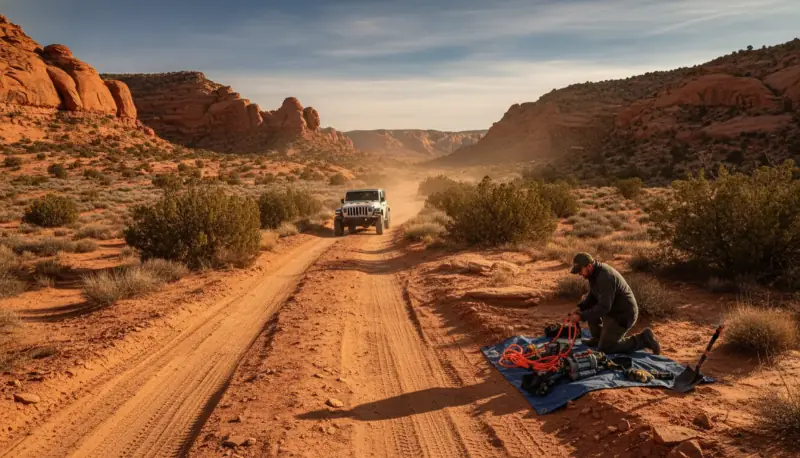
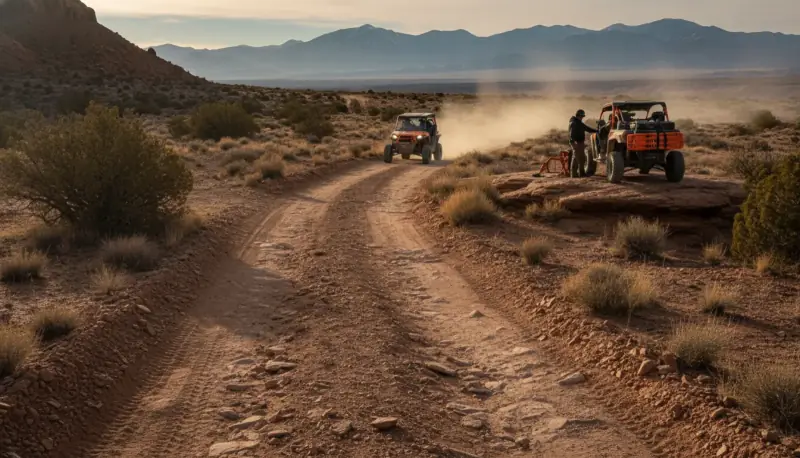
UTV and SxS recovery differs fundamentally from Jeep recovery. Your RZR, Talon, or Maverick weighs roughly 1,500–2,000 pounds against a Jeep's 4,000-plus, carries its loads on thin-wall frame tubes instead of heavy boxed rails, and bolts recovery gear to plastic-lined structures rather than steel bumpers. Using Jeep-spec recovery hardware on a side-by-side isn't just overkill: it introduces weak points where your machine, not the gear, becomes the thing that breaks. This checklist covers gear that actually works for OHV park riding: load-rated for SxS weight and geometry, fast to deploy trail-side, and field-proven by operators in Texas, Utah, and Arizona parks.
Winch and Mounting
A winch is the backbone of solo recovery. Unlike Jeep winches (usually 10,000–12,000 lbs), UTV winches range from 3,000 to 5,500 lbs, plenty for self-recovery on moderate terrain when rigged with proper anchor points. The catch: mounting is everything. Plastic bumpers flex under load and will deform or snap if you don't distribute tension across reinforced frame sections.
- Use a model-specific winch mount plate that bolts to the main chassis tube, not cosmetic body panels. Most quality mounts are laser-cut steel plate with reinforcing tabs; expect them to add 15–20 pounds.
- Never drill new holes in the frame unless you're certain the underlying metal is solid, most SxS frames are thin-wall tube with hollow sections that won't hold a thread. If you're not confident in the load path, ask the dealer or pull the frame spec sheet first.
- Learn to inspect synthetic rope. Fraying, burns, and cuts let rope slip under load or fail outright. Spool it neatly after every use so layers sit flat; overlaps catch and snag during deployment. Carry a spare spool if you range far from civilization.
Traction and Towing Hardware
Your recovery success depends on anchor points your machine can trust. Standard frame loops are fine for their rated use, tie-downs during transport, but on most SxS platforms they're thin-wall steel that was never rated for dynamic recovery loads. Upgrade to a dedicated tow hook or recovery point that spans the tube diameter and takes a load-rated shackle.
- Steel bow shackles: carry the recovery standard, 3/4-inch screw-pin bow (D-ring) shackles with a 4.75-ton working load limit. Smaller hardware-store shackles carry a fraction of that rating; check the WLL stamped on the bow, not the size, before trusting one.
- Soft shackles: for angled pulls, a soft shackle has a real edge: lighter, no projectile risk if something fails, and it flexes to sit naturally against an off-axis anchor instead of side-loading a steel pin. It also spreads load across the attachment point, which matters on plastic-reinforced frames.
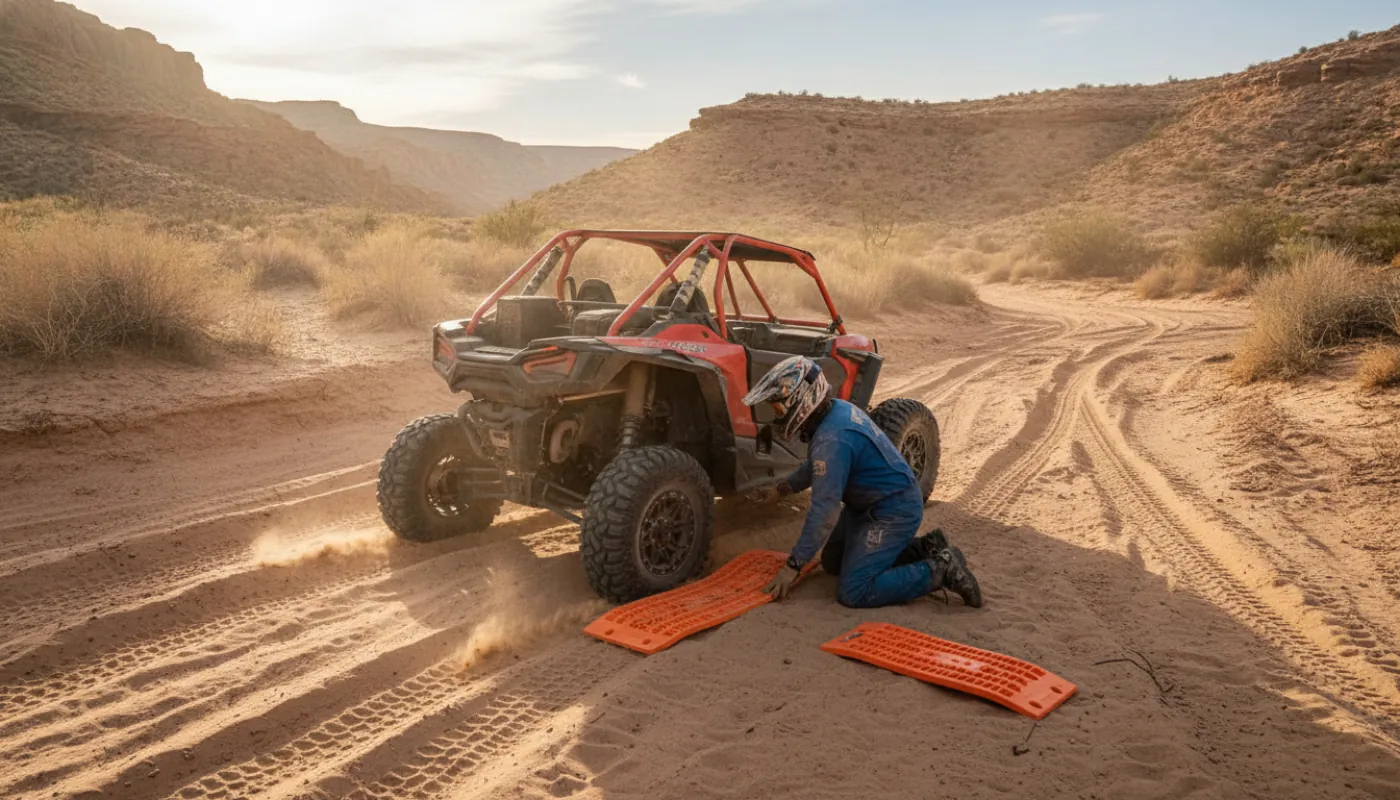
- Traction boards: SxS tires are tall but narrow, roughly 9–11 inches of tread width on a 28–32 inch tire, so you don't need oversized boards. Full-size 45-inch boards work fine; UTV-specific shorter boards trade a little bridging length for rack space. Stack them flat on the rear rack or under the rear bumper where they're reachable but clear of suspension travel.
When recovering another stuck rider, double-check the anchor point on their machine too, a broken frame tab ends the recovery and strands both vehicles.
Straps and Rigging
Recovery straps for SxS machines should be rated 8,000–12,000 lbs minimum breaking strength. Many riders default to 20,000-lb Jeep straps, which are overkill and harder to handle from a passenger seat. An 8,000-lb strap paired with a soft shackle gives you the safety margin without the bulk. Nylon webbing with sewn loops is more durable than snap-hook versions, and hook-ended straps have no place in recovery rigging anyway.
- Carry at least two straps. A two-strap setup distributes load across multiple anchor points on both vehicles, reducing stress on any single frame point.
- Color-code them (one red, one yellow) so you can call them out to a spotter, "wrap the yellow around the frame tube" beats pointing at dark straps in dust.
- Skip chain. It's heavy, slow to rig, catches body panels, and shock-loads violently. Steel cable is a distant second to synthetic rope: it kinks, rusts if stored damp, and needs monthly inspection plus a light oil coat if you insist on carrying it.
Anchor and Bracing
Finding a solid anchor in the field is half the recovery problem. Rocks, trees, and soil anchors all work, if you rig them right.
Kinetic strap. Carry a kinetic energy strap (snatch strap) for vehicle-to-vehicle recovery: a second rig accelerates, the strap stretches and rebounds, and that stored energy pops you free without the violent jerk of a static tow. Size it by the industry rule, breaking strength of 2–3× your machine's gross weight, so a 2,000-lb SxS wants a strap in the 6,000-lb-plus class, and the common 12,000-lb kinetic strap covers any side-by-side with margin. One hard rule: a kinetic strap is never spliced into a winch line to "cushion" it. Winching is slow and static; its shock-load is controlled by feathering the throttle and a winch-line damper, not by adding stretch.
Tree anchors. Use a wide tree-protector sling to distribute load across bark and wood, wrapped low, within a few feet of the base, so the pull loads the trunk, not the canopy.
Rock anchors. Only rocks anchored in the ground. Test by pulling hard by hand first; a rock that shifts an inch under hand pressure will flip under 3,000 lbs of winch load.
Soft ground. If the only anchor is sand or loose soil, bury a deadman: a 2–3 foot plate, board, or spare traction board set vertically in a trench, perpendicular to the direction of pull, with the winch line running in-line to it through a slot in the sand. Done right, the whole face of the buried plate bears against undisturbed ground.
Recovery Tools and Extras
Your tool kit should fit a 16–20 quart box mounted under the seat or strapped to the frame:
- Adjustable wrenches (10-inch and 13-inch) and a socket set (9–22mm)
- Pliers and a strap wrench
- A folding shovel, most SxS recoveries are half-dig, half-winch; the shovel saves hours and weighs almost nothing
- Penetrating oil (PB Blaster or equivalent) for corroded fasteners, desert riding eats metal fast
- Two sets of gloves: leather for rope and straps (winch rope burns bare hands), mechanics' gloves for frame work
Deflation and Float Recovery
Sand and snow recovery often starts with letting air out to grow the tire's footprint.
- Tire deflator: screws onto the valve stem and bleeds air at a controlled rate, so you can drop from a ~15 psi trail baseline to 8–10 psi without kneeling in the sand holding a valve. Check your tire's sidewall guidance and treat ~8 psi as the floor, lower risks unseating a bead on sharp rocks.
- 12V air compressor: keep a good one in your trailer for the trailhead, and a compact unit on the machine if you air down often. Refilling four SxS tires from 10 to 18 psi takes about 15 minutes with a decent portable unit.
- Water: know your machine's fording depth and don't exceed it. Even with a snorkel, a stalled engine in moving water can trap you, deep-water recovery needs a bigger winch and solid ground anchors. Don't attempt it solo.
Packing and Weight Management
The full kit (winch and mount, rope, straps, shackles, boards, and tools), adds a real 100–150 pounds, and where it rides matters on a narrow platform. Stack it all on the rear rack and the front end goes light in climbs. Mount heavy gear low and forward: winch on the frame, tools in mid-frame boxes, boards flat rather than high.
Test your packed rig on easy trails before hitting difficult terrain. A machine that handles fine empty might wallow in rocks when loaded, and sometimes leaving a second strap at base camp is smarter than adding instability.
Recovery gear is insurance you hope never to use. But in an OHV park where cell service is spotty and help is a long ride away, the right checklist keeps you self-reliant and brings friends home safely.