The difference between a rewarding afternoon and a rolled rig often comes down to one thing: understanding what that trailhead sign actually means. Trail difficulty ratings exist to communicate risk, terrain complexity, and vehicle requirements before you commit. But if you're new to off-roading, ratings can feel like a foreign language, partly because there is no single national standard. Federal agencies, state parks, private operations, and local clubs each rate trails their own way, and a "black diamond" at one park plays nothing like another. The goal of this guide is to decode the systems you'll encounter and give you a framework for making smart choices before you're stranded at a creek crossing wondering if that step-down was supposed to be there.
The Standard Rating Systems You'll Encounter
The green-circle / blue-square / black-diamond color system is the one you'll see most often at trailheads, but it's worth knowing where it comes from. It's a convention borrowed from ski-resort signage and adopted by many off-road parks, apps, and clubs, not an official federal scale. The U.S. Forest Service's own "Trail Class 1–5" numbers, which you may see in agency documents, aren't a difficulty score at all: they're a development scale describing how built-out a trail is, running from Class 1 (minimally developed, most primitive) up to Class 5 (fully developed, even paved), so don't read a Trail Class number as a challenge rating. Where the color system is used, it usually pairs the color with what you risk if you mess up. Because no one owns the color system, the exact meaning shifts from park to park, always cross-check against the local map legend.
Alongside the colors, you'll encounter the numbered 1–10 scale, common in regions with organized off-road parks, and descriptive ratings (Easy, Intermediate, Advanced, Expert), which are intuitive but vague. The strength of park-set standards is local calibration; the weakness is that "advanced" at a groomed park in Arizona plays nothing like "advanced" on a rocky backcountry trail in Utah.
What the Numbers and Colors Actually Mean on the Ground
| Rating | Numeric | On the ground | What you need |
|---|---|---|---|
| Green circle / Easiest | 1–3 | Gentle grades, wide obvious lines, ruts and small rocks; mistakes rarely have consequences | Stock vehicle, common sense |
| Blue square / Intermediate | 4–6 | Real obstacles: water crossings, narrower lines, steeper pitches, careful line choice; a 6 separates people from parking-lot rigs | Working 4WD, reasonable clearance, growing judgment |
| Black diamond / Advanced | 7–9 | Steep descents, aggressive rock gardens, narrow canyon runs; mistakes cost parts | Lockers, armor, winch, sharp skills |
| Double black / Extreme | 10 | Competition-grade crawling, near-vertical terrain, rollover exposure | Purpose-built rig, spotters, a rescue plan, or acceptance of a tow |
Reading the bands in more detail: a 2 might have one or two rocky sections, but the line is obvious and forgiving, while a 3 pushes slightly, sustained elevation change or a short boulder field, with straightforward recovery. A 4 introduces obstacles that demand attention but punish only carelessness; a 5 has you picking lines carefully, possibly with a spotter. At 7 winch recovery becomes a real possibility; an 8 demands serious hardware; a 9 is expert-level technical crawling where your vehicle is built for it, your skills are sharp, and the ride might still be gnarly. Only go to a 10 if you've decided it's worth potentially losing the rig for a day of bragging rights.
Reading the Terrain for Clues Beyond the Rating
The rating system is a starting point, not a guarantee. You'll become a better chooser by learning what terrain indicators actually mean.
- Water crossings are confidence breakers for beginners, even a shallow creek can hide a ledge or wash out your exhaust. Look for high-water marks on rocks and trees; if they're above your door sills, skip it.
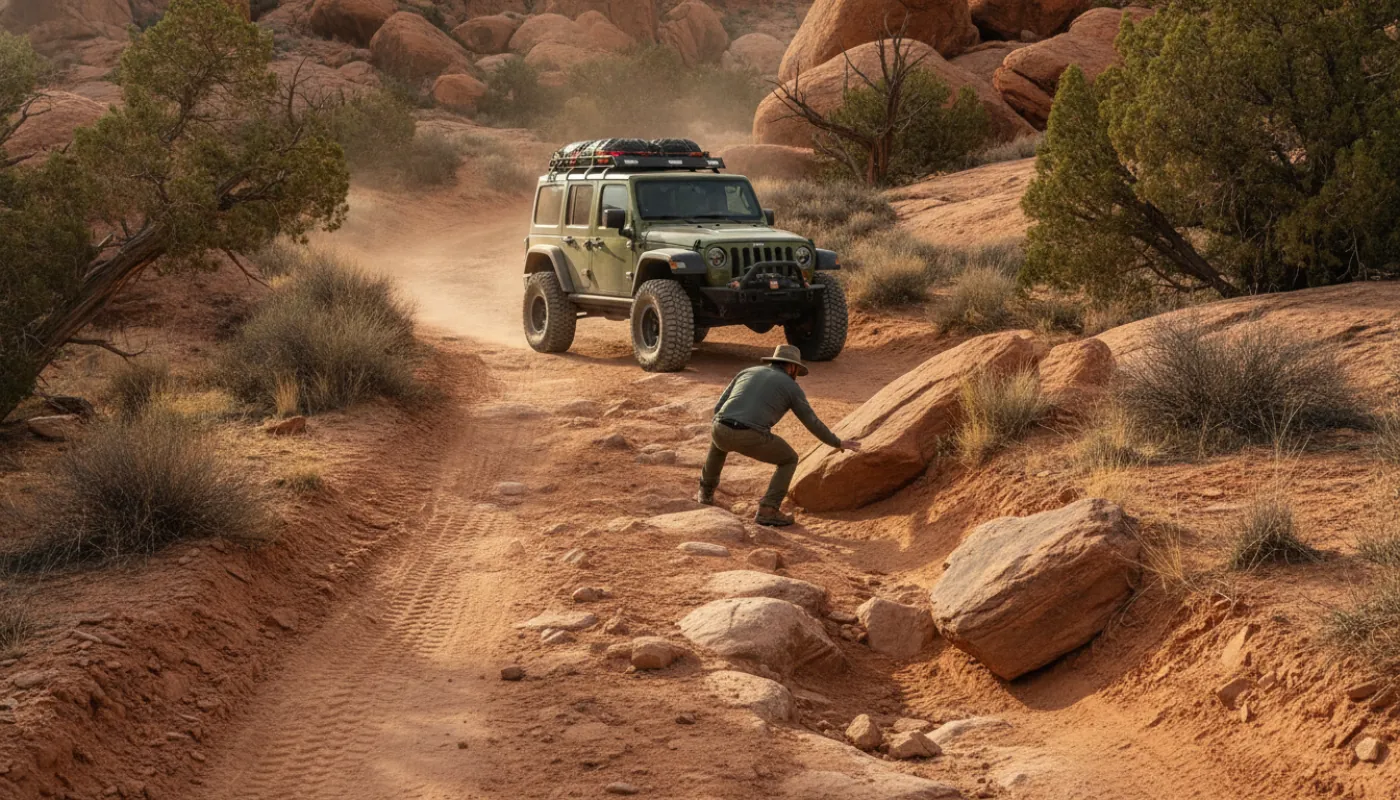
- Rock character reveals the trail's personality. Scattered fist-sized rocks are manageable; a continuous talus field of head-sized boulders changes the game. Walk the gnarliest section before you attempt it.
- Grade plus surface matters more than grade alone, a 20% climb on hardpack is a different animal than 20% on loose scree or sand.
- Switchbacks are respect for physics. A descent with turns carved into it was built by people who cared about your brakes. Straight plunges suggest advanced riders or a park that's okay with accidents.
- Vegetation talks. Fresh scrapes on junipers mean recent traffic and probably rough ground; overhanging branches suggest light use and possibly overgrowth hiding hazards.
Ask around before you go. Park rangers, local clubs, and the park's social groups give you the texture ratings miss: a green trail with fresh water damage might run sticky, and a recently cleared blue can run cleaner than its rating.
Matching Your Vehicle and Skill to the Right Trail
Start conservative. If you're in a stock Jeep or UTV, greens and easy blues are your lane, no shame in it; you're learning the terrain and your rig's quirks. As your skills sharpen and you invest in the vehicle (lockers, tires, recovery gear), you graduate. A Jeep with good tires and a winch can handle a 5. A purpose-built crawler will bore its driver below a 4.
Your experience matters more than the vehicle. Someone who drives technical terrain weekly and understands their machine's limits can handle a 6; someone who goes out three times a year should stick to a 4, no matter what they're driving. Difficulty is a conversation between the terrain, your rig, and your judgment. Respect that hierarchy.
Weather and season change the conversation too. A 4 that's manageable in dry September becomes a 6 in November after rain. Snow and ice bump everything up a tier. If conditions are marginal, bump your target rating down.
Building Your First Outing Checklist
Your first technical trail should be a solid blue, a 4 or 5, approached like this:
- Scout it in daylight, at a time when the park is busy, so help is nearby.
- Bring recovery gear: kinetic rope, shackles, and recovery points rated for your vehicle's weight.
- Bring a spotter who understands communication and isn't afraid to say "stop."
- Pack the safety layer: water, basic tools, first aid, and a satellite communicator, phones die in canyons.
- Walk the hardest sections before you drive them. Understand the line, the consequence, and your exit plan.
- Drive it slowly. There's no award for speed on technical terrain. If something feels wrong (slipping tires, overheating, unresponsive handling), stop and assess. The trail isn't going anywhere.
You learn difficulty ratings not just by reading them but by experiencing them. A 5 that felt hairy last year feels routine now. That's the learning curve. Trust it and progress at your pace.