Moab draws more off-roaders than almost anywhere else in North America, and spring is the season they come. March through May offers cooler temperatures than summer, longer days, and desert light that cuts sharp through morning dust. But spring is also unforgiving. The season that makes Moab's red rock accessible is the same season that transforms clay into grease and closes routes without warning. Your rig and your paperwork need to match the season, or you'll spend more time recovering than riding.
Spring Weather Patterns and Trail Conditions
Spring in Moab is a collision of weather systems. Temperatures swing 30 degrees from sunrise to midday, then plunge again when afternoon storms roll in off the La Sals. Moab is genuinely arid, March and April each average around an inch of rain, but a single storm can drop half a month's total in an afternoon, and that's all it takes. The result is a landscape that looks perfect on Monday and greasy by Wednesday.
The mud season, roughly late March through May, is when clay surfaces become actual hazards. The slickrock itself sheds water fast; the problem is the clay-rich soils weathered from the shale and mudstone layers between the sandstone. After snowmelt or rain those sections stay wet and frictionless for days. Even a Rubicon on fresh rubber gets sketchy when the surface is slick clay, and UTVs lose the grip that saves them on rock.
Two more spring realities to plan around:
- Runoff. The handful of routes with live creek and wash crossings swell with snowmelt, and depth changes by the hour. Deep-water fording is rare in Moab, the real spring problem is mud, not submersion.
- Delays. Storm cells move fast off the mountains. Plan for at least one weather delay per week-long trip in May.
Navigating Permits and Closures
Moab straddles multiple jurisdictions, and each has different requirements. Sorted by what actually applies to you:
| Requirement | Who it applies to | Cost |
|---|---|---|
| Sand Flats Recreation Area day pass | Every vehicle entering (Hell's Revenge, Fins & Things) | ~$10 per vehicle (7-day); ~$5 motorcycle; $35 annual |
| Utah non-resident OHV permit | Out-of-state ATVs, UTVs, and dirt bikes | ~$30, valid 12 months |
| Utah OHV education course | All OHV operators, residents and visitors alike | Free, online |
| BLM Special Recreation Permit | Organized group runs and commercial trips | Varies |
Most of the iconic BLM trails, Poison Spider Mesa among them, don't require a per-trail permit for casual day use in a street-legal vehicle. Hell's Revenge and Fins & Things are the notable exception: they sit inside the Sand Flats Recreation Area, cooperatively managed by the BLM and Grand County, with the fee collected at the entrance station.
If you're trailering a UTV or dirt bike from out of state, two things the fee booth won't sell you: Utah requires every OHV operator to have completed the state's free OHV education course, and non-resident machines need the Utah non-resident OHV permit before they touch dirt. Both are handled online, do them before the trip, not in the parking lot.
Closures are the other spring variable. The BLM can and does close routes when conditions turn dangerous or resource damage becomes likely, and conditions change fast in mud season. Check with the BLM Moab Field Office or the Moab Information Center (run by Discover Moab) the day before you drive, and treat trailhead kiosk postings as current. Local outfitters usually have the freshest real-time intel.
Spring Vehicle Preparation
Spring mud demands a different rig setup than summer slickrock touring.
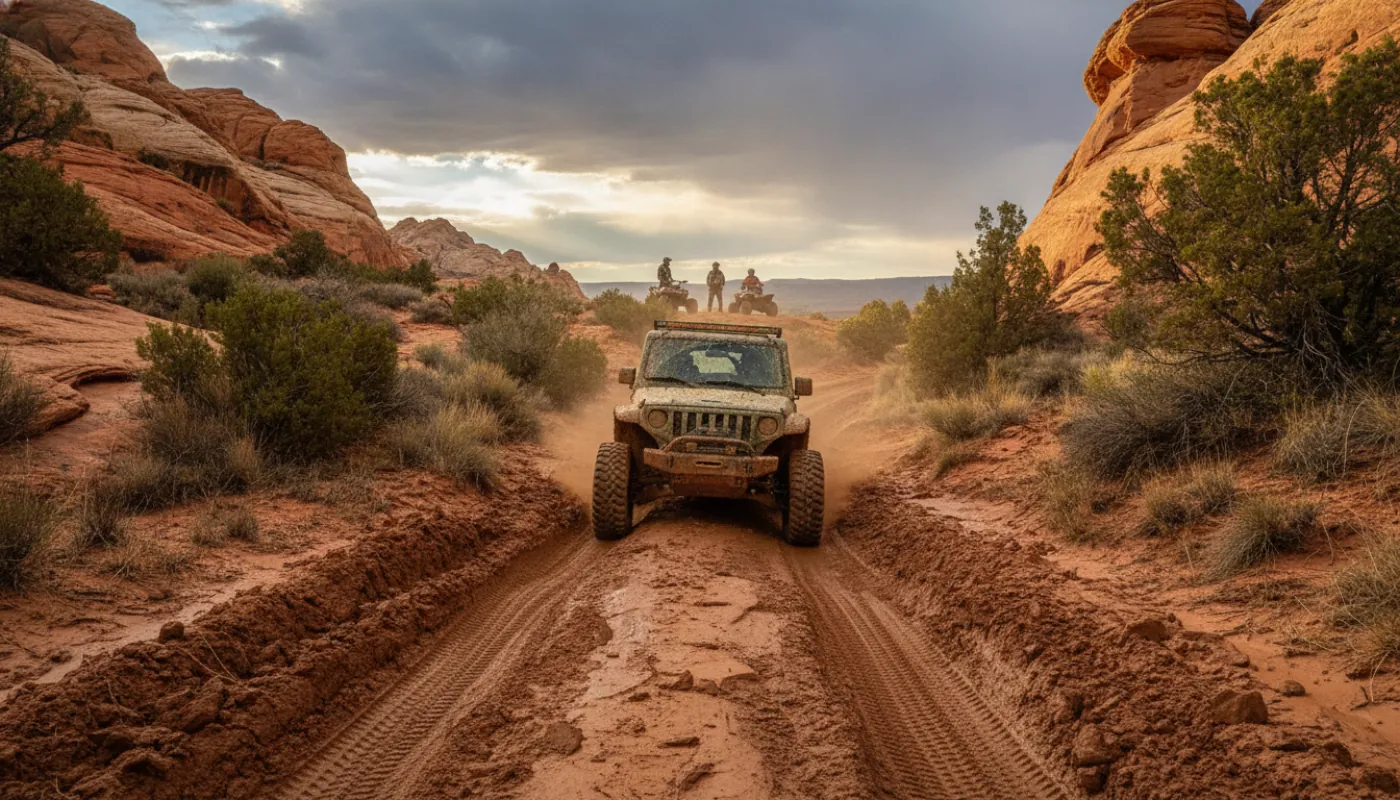
Tires. All-terrain tires with aggressive tread help in mud far more than going wider. Dedicated mud tires hold clay better but give up grip on the rock that makes up most of a Moab day; if you're mixing Hell's Revenge slickrock with clay approach roads, an aggressive A/T is the safer middle ground.
Pressure. Lower pressure (15–18 psi) puts more tread on slick clay, but you risk sidewall damage on sharp rock. Most experienced Moab spring runners air down only for the muddy sections, then air back up to crawl.
Clearance and armor. The real killer in spring mud is getting high-centered: mud gives you no feedback until you're already stuck, and spinning tires pack it tighter around the undercarriage. Skid plates and rock sliders pay off in spring because steering is less precise on slick surfaces and you'll contact rock you'd normally steer around. Know the depth of any crossing before you commit, talk to rigs coming the other way or check recent trip reports.
Spring Trail Selection by Experience Level
Spring conditions change the effective difficulty of almost every route, so build your week as a progression:
| Trail | Baseline difficulty | Spring character |
|---|---|---|
| Fins & Things | Moderate | Sand bowls drain fast; good early-trip shakedown |
| Hell's Revenge | Moderate-plus | Steep slickrock domes and sand, sheds water quickly, but wet rock unsettles new drivers |
| Poison Spider Mesa | Difficult | Dry mesa ledges and rock obstacles; the "Waterfall" is rock, not water |
| Gold Bar Rim | Difficult | Big ledges and exposure: lockers, 35s, and prior Moab experience; not a confidence-builder |
Two spring-specific notes:
- The famous Slickrock Trail is not a 4x4 route. It's open to motorcycles and bicycles only, Jeeps and UTVs are prohibited except where Hell's Revenge crosses it. Plenty of first-timers plan around it by mistake.
- April is the sweet spot for a first Moab trip: early enough that the desert is still cool, late enough that the worst mud has cleared. Run Fins & Things first, then Hell's Revenge, and only step up to Poison Spider or Gold Bar Rim once you've felt how spring conditions change your rig's behavior.
Critical Spring Recovery and Gear
Spring mud demands specific recovery gear beyond the summer kit:
- Two long-handled shovels, you will lose one in the mud.
- Traction boards, mud-pattern boards with wide surface area and aggressive texture outperform sand ladders in clay.
- A jack that works in slop, a hi-lift with a base plate, or an air jack; a standard floor jack sinks and won't function.
- Winch, with realistic expectations, valuable only with solid anchors; in deep suction mud a winch strains long before the mud lets go, so dig first.
- Redundant communication, a satellite messenger or PLB, not just a phone. Utah canyons lose signal fast when weather moves in.
- Cold-weather margin: spare fuel, extra water, and a warm layer. Temperatures can drop 40 degrees from noon to sunset, and extraction in cold rain is a different problem than a summer breakdown.
Most importantly: don't run alone in spring, and leave your itinerary and expected return with someone outside your group. Spring conditions can trap you, and a second rig makes extraction infinitely easier.